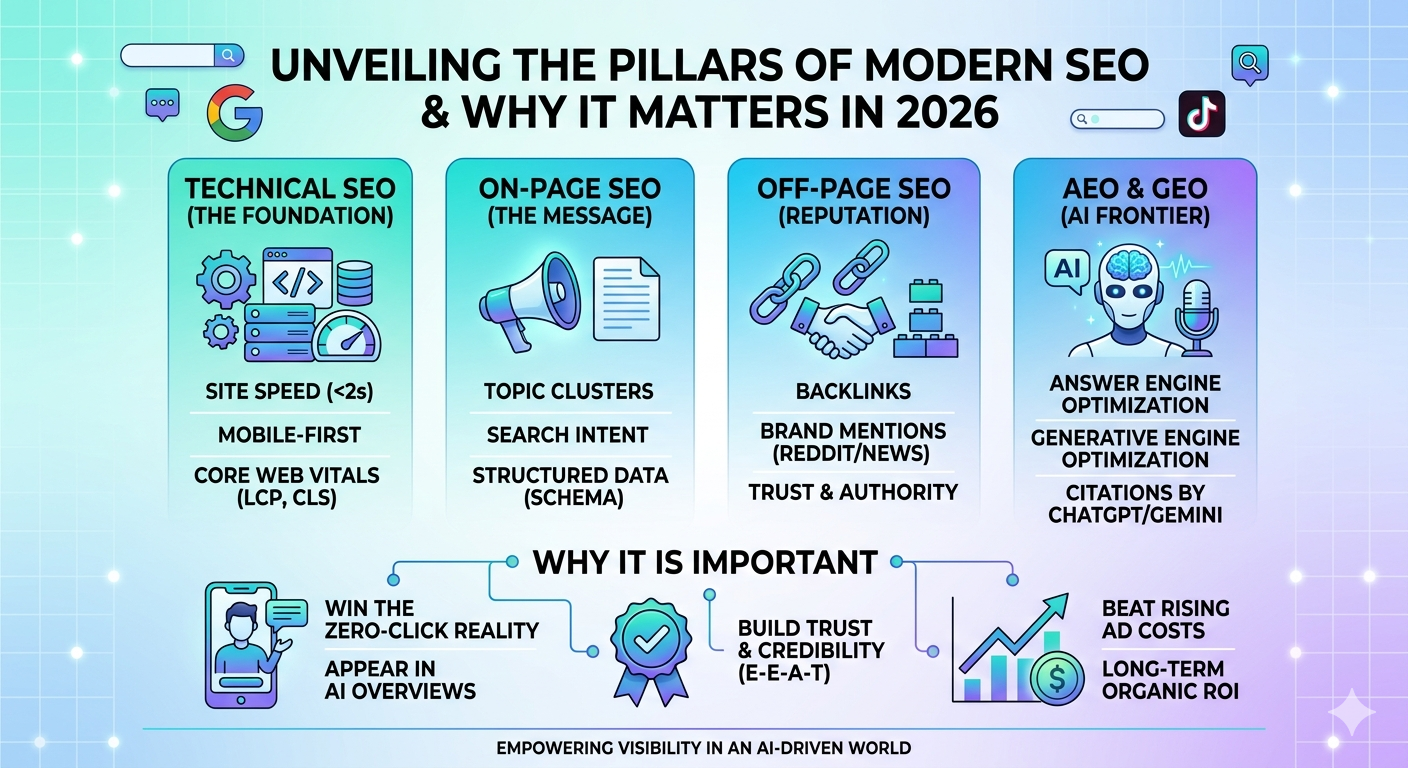
What is SEO?
At its core, SEO is the process of improving your website so that search engines (and AI models) can understand, trust, and recommend your content to users. It is generally broken down into four "pillars":
1. Technical SEO (The Foundation)
This is the "under the hood" work. If your site is a mess technically, search engines won't even bother looking at your content.
-
Site Speed: Users expect pages to load in under 2 seconds.
-
Mobile-First: Since mid-2024, Google almost exclusively indexes the mobile version of websites.
-
Core Web Vitals: Specific metrics like LCP (loading performance) and CLS (visual stability) are now mandatory for ranking.
2. On-Page SEO (The Message)
This involves optimizing the actual content on your pages so it "speaks the language" of search engines.
-
Topic Clusters: Instead of targeting one keyword (e.g., "blue shoes"), you create a hub of content around a broad topic ("sustainable footwear guide") to prove you are an authority.
-
Search Intent: Providing the exact type of answer the user wants—whether they are looking for information, a specific website, or to buy a product.
-
Structured Data (Schema): Using special code to tell search engines exactly what a piece of data is (e.g., "this is a price," "this is a recipe," "this is an FAQ").
3. Off-Page SEO (The Reputation)
This is about your site’s "street cred."
-
Backlinks: When other reputable sites link to yours, it acts as a vote of confidence.
-
Brand Mentions: Even if a site doesn't link to you, simply being mentioned on a trusted platform (like Reddit or a major news site) helps AI models recognize you as an "Entity."
4. The New Frontier: AEO & GEO
In 2026, we also optimize for Answer Engine Optimization (AEO) and Generative Engine Optimization (GEO). This means structuring your content so that AI assistants (like Gemini or ChatGPT) can easily pull quotes and cite you as their source in an AI-generated summary.
Why is SEO Important?
1. The "Zero-Click" Reality
As of 2026, roughly 60% of searches end without a user ever clicking on a website because they get their answer directly from an AI Overview. If you aren't optimized, your brand won't even be mentioned in that answer. SEO ensures you are the source that the AI trusts.
2. Trust and Credibility (E-E-A-T)
Search engines prioritize content that demonstrates Experience, Expertise, Authoritativeness, and Trustworthiness. High SEO rankings act as a "seal of approval." Users inherently trust the top results more than the ones buried on page two.
3. Competing with Rising Ad Costs
The cost-per-click (CPC) for paid ads continues to rise (often by 8-12% year-over-year). SEO provides organic traffic, which is essentially "free" once the initial work is done. It offers a much higher long-term ROI than paying for every single click.
4. It’s an Omnichannel World
SEO isn't just for websites anymore.
-
Social Search: People search for reviews and "how-to" videos on TikTok and YouTube.
-
Local Search: For physical businesses, local SEO (Google Business Profiles) is the primary way people find services "near me."
The Bottom Line: SEO is the only digital marketing strategy that builds long-term equity. While ads stop the moment you stop paying, a well-optimized SEO ecosystem continues to bring in customers, build your brand's authority, and keep you relevant in an AI-driven world.