
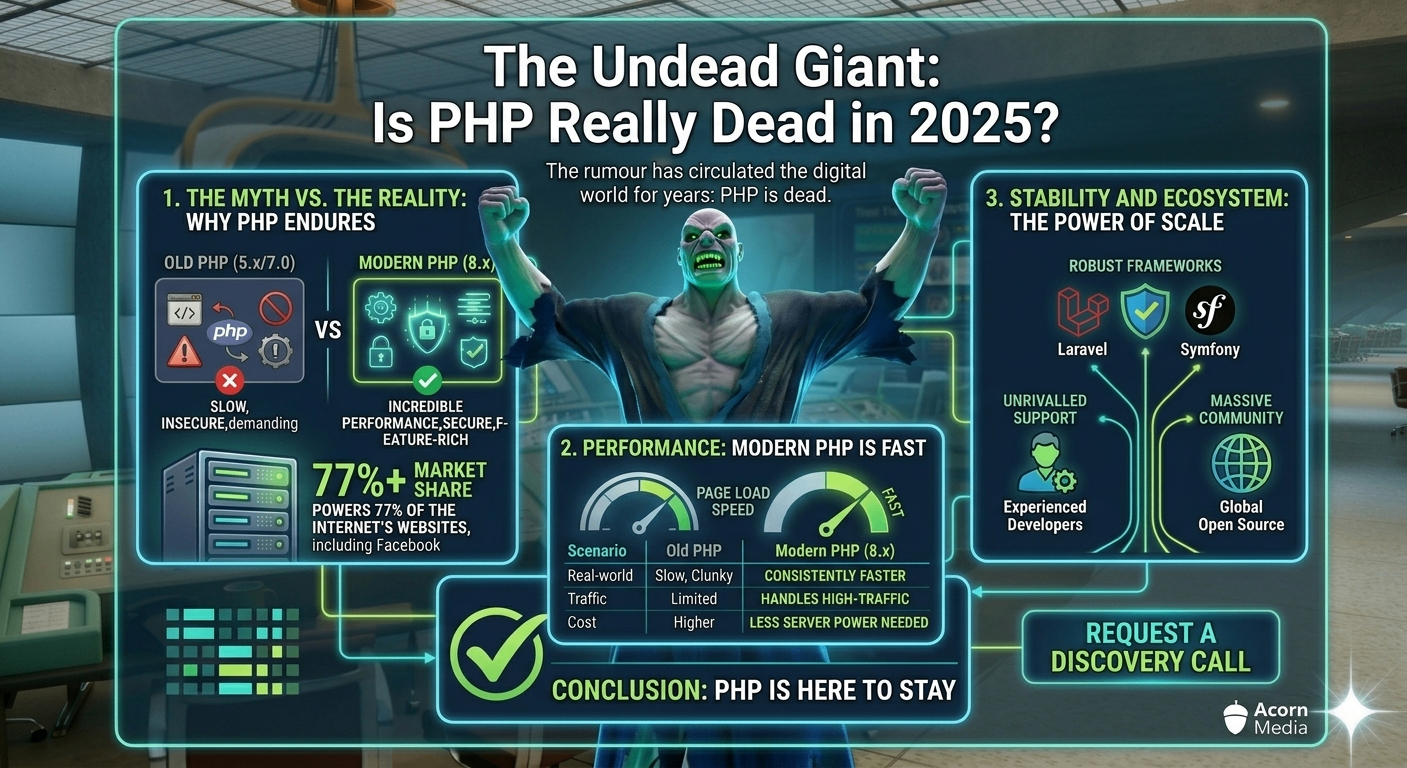
⚰️ The Undead Giant: Is PHP Really Dead in 2025?
The rumour has circulated the digital world for years: PHP is dead.
Go to any developer forum and you’ll find plenty of debate, often fuelled by zeal for newer languages like Python, JavaScript, and Go. But when a programming language powers over 77% of the entire internet's websites—including giants like Facebook —can it truly be considered obsolete?
The answer is a resounding no. Not only is PHP alive, but modern versions are faster, more secure, and more feature-rich than ever before.
For any business making critical technology choices in 2025, understanding the truth about PHP is essential.
1. The Myth vs. The Reality: Why PHP Endures
The "PHP is dead" narrative stems from two main issues: its past limitations and its popularity among older, poorly maintained websites.
The Old PHP: Legacy systems running PHP versions 5.x or 7.0 were indeed slow, lacked modern conventions, and were highly insecure. This is the PHP that critics remember.
The Modern PHP (8.x): Current versions (PHP 8.x) offer incredible performance improvements due to a major rewrite of the execution engine. It now supports modern object-oriented programming, typed properties, and a 'Just-in-Time' (JIT) compiler.
The Reality Check: Any reputable web development company using PHP today is building on modern, high-performance frameworks like Laravel or Symfony, which bear little resemblance to the old, clunky systems of the past.
2. Performance: Modern PHP is Fast
The number one criticism of PHP—speed—is simply no longer valid.
With the introduction of the JIT compiler in PHP 8, the language gained significant performance boosts. In real-world scenarios, PHP 8 is consistently shown to perform faster than previous versions and can easily handle high-traffic demands.
For you, the business owner, this means:
Better UX: Faster page loading times reduce bounce rates and improve user experience.
Lower Hosting Costs: Improved efficiency means modern PHP requires less server power to handle the same load, saving money on hosting infrastructure.
3. Stability and Ecosystem: The Power of Scale
No other language offers the stability and ecosystem PHP does. The fact that the entire digital world relies on it is its greatest strength.
Unrivalled Support: With over 77% market share, finding experienced PHP developers is easier than for almost any niche language. This reduces risk and ensures long-term support.
Robust Frameworks: PHP's modern frameworks (Laravel, Symfony) are mature, secure, and offer clear conventions for building large, scalable applications, from e-commerce platforms to bespoke CRMs.
Massive Community: Any problem you encounter has likely already been solved by its vast, global open-source community.
4. When is PHP the Right Choice in 2025?
While there are many excellent programming languages, PHP remains the optimal choice for several core business needs:
| Scenario | Why PHP Excels |
|---|---|
| High-Volume Content Sites | Powers WordPress, the global CMS standard. Best for blogs, news sites, and simple brochure sites. |
| Bespoke Web Applications | Laravel and Symfony allow for secure, clean, and rapid development of custom applications and tools. |
| E-commerce | Underpins platforms like Magento and WooCommerce, offering proven stability for major transactional sites. |
Conclusion: PHP is Here to Stay
The question isn't whether PHP is dead; it's whether your current technology partner understands how to use its modern, powerful iterations.
For any business seeking a stable, scalable, and high-performance website build, modern PHP built on a framework like Laravel remains one of the smartest, most reliable choices available. Don't let old rumours guide your future technology investment.
💡 Ready to discuss the best tech stack for your next project?
Book a free Technology Strategy Session with our expert developers today.